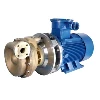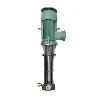
Centrifugal pumps are primarily composed of an impeller, pump casing, pump shaft, bearings, sealing devices, and a motor; among these, the impeller and pump casing are the key components for fluid transport. The motor provides power to the pump, driving the impeller to rotate at high speed via the shaft, thereby imparting energy to the fluid entering the casing. While different models of centrifugal pumps vary in structure and dimensions, their basic composition is similar, with the various components working in concert to perform fluid suction, pressurization, and discharge.
The impeller is one of the most critical working components of a centrifugal pump and is typically mounted on the pump shaft. Upon motor startup, the shaft drives the impeller to rotate rapidly; fluid entering the impeller's center is propelled toward the outer edge by centrifugal force, gaining both velocity and pressure in the process. Factors such as impeller shape, diameter, number of vanes, and vane angle influence the pump's flow rate, head, and efficiency. Impellers can be designed with various structural configurations to suit specific operational requirements, such as handling clean water, oil, or fluids containing minor impurities.
The pump casing serves to house the impeller and provide flow channels for the fluid. After entering the casing through the suction inlet, the fluid moves outward under the impeller's action and enters the internal flow passages of the casing; here, a portion of the kinetic energy is converted into pressure energy before the fluid is discharged through the outlet. The pump shaft transmits power from the motor to the impeller and must possess sufficient strength and rigidity. Bearings support the pump shaft, minimizing friction during rotation to ensure smooth operation. For high-speed centrifugal pumps, bearing performance directly impacts equipment vibration levels and service life.
Sealing devices are typically installed at the interface between the pump shaft and the casing to prevent fluid leakage through the gap and to keep air from entering the pump. Common sealing methods include mechanical seals and gland packing. Additionally, centrifugal pumps are equipped with auxiliary components such as couplings, baseplates, inlet/outlet flanges, and pressure gauges. The coupling connects the motor to the pump shaft, while the baseplate supports the entire assembly. Through the coordinated action of these components, centrifugal pumps reliably transport fluids, making them widely used in industrial production, water supply and drainage, agricultural irrigation, and equipment circulation systems.