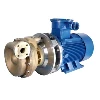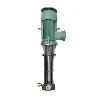
A reciprocating pump is a positive-displacement pump that transports liquid through the reciprocating motion of a piston or plunger; its fundamental operating principle involves altering the internal volume of the pump chamber to facilitate liquid intake and discharge. During operation, the motor drives a transmission mechanism-such as a crank and connecting rod-to convert rotary motion into the reciprocating motion of the piston or plunger. As the piston moves backward, the pump chamber volume increases and internal pressure drops, drawing liquid into the chamber due to the pressure differential; conversely, as the piston moves forward, the chamber volume decreases and internal pressure rises, forcing the liquid out into the discharge piping.
The intake and discharge processes rely primarily on the automatic opening and closing of suction and discharge valves. During intake, the suction valve opens while the discharge valve closes, allowing liquid to enter the chamber; when the piston begins to compress the liquid, the suction valve closes and the discharge valve opens, expelling the liquid through the outlet. Continuous liquid transport is achieved as these two processes repeat with the piston's ongoing reciprocating motion. Although the discharge process of a single piston is intermittent, the use of multi-cylinder configurations or appropriate damping devices can smooth out the output flow.
A notable characteristic of reciprocating pumps is their ability to generate high pressures, with flow rate determined primarily by the piston's speed, stroke length, and the number of pump cylinders. In practical applications, these pumps can continue to transport liquid even against high discharge-line pressures, provided the pump's power and structural integrity meet the requirements. Consequently, they are well-suited for high-pressure transport, metering/dosing, and applications requiring stable pressure. However, because reciprocating motion inherently generates flow pulsation and mechanical vibration, actual installations typically incorporate safety valves, air chambers, or other damping devices to optimize operational performance.
In summary, a reciprocating pump utilizes the reciprocating motion of a piston or plunger to vary the pump chamber's volume, completing the intake, pressurization, and discharge of liquid through the alternating action of suction and discharge valves. Throughout this process, the motor provides power, the transmission mechanism converts the motion, the piston or plunger varies the chamber volume, and the valves regulate the direction of liquid flow. Through the coordinated interaction of these components, reciprocating pumps are capable of transporting liquids at high pressures; consequently, they find widespread application in sectors such as the petroleum, chemical, and machinery manufacturing industries, as well as in boiler feed systems and high-pressure cleaning operations.